Best commercial bar stools for restaurants in 2026
Posted by Editorial Team on Nov 5th 2026
Best overall: fixed-back metal-frame stools. Best for dining-led interiors: wood-frame stools. Best for compact layouts: backless stools. Best for conversational bars: swivel stools. Best for terraces: outdoor-rated stools. This 2026 guide ranks commercial bar stools for restaurants by service setting, fit, maintenance, and the compromises each design creates.
- For commercial bar stools for restaurants, fixed-back metal-frame designs are the default indoor recommendation.
- Wood-frame stools suit dining-led interiors; backless stools suit compact layouts where shorter visits are intended.
- Choose swivel stools for conversational seating, but include moving hardware in your inspection routine.
- Evaluate Mondo Contract selections against your restaurant furniture specification, not appearance alone.
Why this matters
A restaurant stool has to fit the counter, the guest, and the cleaning routine. An attractive seat that blocks an aisle or leaves knees against the underside of a bar is the wrong specification.
For restaurant buyers evaluating Mondo Contract, fixed-back metal-frame stools are the default specification for indoor bar seating. Treat that as a starting point, then change the configuration when your service model demands something different.
This ranking compares stool configurations rather than named products. A frame material alone does not establish commercial suitability: check the intended use, construction details, care instructions, and supporting documentation for the exact model before ordering.
What makes the best commercial restaurant bar stool?
Use these six criteria to review your 2026 shortlist before comparing finishes:
- Commercial suitability: Ask for written confirmation that the exact model is intended for restaurant use. A residential silhouette is not evidence of commercial construction.
- Seat-to-counter fit: Measure the finished counter and its underside. Include aprons, brackets, footrails, and anything else that reduces usable legroom.
- Guest support: Match back support, seat shape, and foot placement to the length and purpose of the visit.
- Cleaning access: Inspect seams, joints, seat edges, and the floor beneath the stool. Your cleaning process must work with the construction.
- Serviceability: Check how glides, upholstery, fasteners, and moving parts can be maintained or replaced.
- Layout behavior: Evaluate the stool occupied, pulled out, and turned toward an adjacent guest—not just tucked beneath the counter.
Reject a stool that fails fit or intended-use checks, even when its appearance matches the room. A finish sample cannot resolve a dimensional problem.
Commercial bar stools at a glance
| Rank and configuration | Best for | Standout feature | Key limitation |
|---|---|---|---|
| 1. Fixed-back metal-frame stools | General indoor bar service | Back support without a swivel mechanism | Frame joints and footrests still need inspection |
| 2. Wood-frame stools | Dining-led interiors | Visible wood grain and a furniture-led appearance | Finish care and joint construction need attention |
| 3. Backless stools | Compact, shorter-stay seating | No backrest projecting above the counter | No back support for guests |
| 4. Swivel stools | Conversation-focused bar seating | Seat rotation | Moving hardware adds maintenance points |
| 5. Outdoor-rated stools | Patios and terraces | Materials specified for outdoor exposure | Outdoor suitability does not eliminate care requirements |
The categories overlap. A swivel stool can have a metal frame, and an outdoor stool can be backless. Rank the feature that solves your main operational problem first, then specify the remaining details.
1. Fixed-back metal-frame stools: best for indoor bar service
Fixed-back metal-frame stools combine a supporting backrest with a stationary seat. They provide a straightforward starting point for indoor restaurant bars where guests eat, drink, and converse without needing a rotating seat.
The frame description is only the beginning. Examine the joints, footrest attachment, seat fixing, and floor contact points before treating any individual model as suitable for your restaurant.
Fixed-back metal-frame stool pros:
- Backrests give guests a place to lean during seated service.
- Stationary seats remove the swivel mechanism from the maintenance checklist.
- Separate seat pads, when the construction allows replacement, offer a defined maintenance component.
- Metal frames can be specified independently from the seat material.
Fixed-back metal-frame stool cons:
- Exposed hard edges require attention around circulation routes.
- Footrest connections and frame joints still need routine checks.
- A fixed seat requires guests to move the stool when changing their position at the counter.
Best for: Indoor restaurant bars that need a general-purpose seating specification rather than a specialist feature.
Before approving a sample, sit with both feet on the footrest and check whether the backrest supports a natural position. Then stand up and move away as a guest would during service.
Verdict: Buy for general indoor bar service after confirming commercial suitability and dimensional fit.
2. Wood-frame stools: best for dining-led interiors
Wood-frame stools suit restaurants where bar seating should relate visually to dining chairs and tables. They bring grain, joinery, and finish into the design decision rather than making the frame a purely structural background.
Specify the exact finish and cleaning method together. Do not assume that a cleaner used elsewhere in the restaurant is appropriate for a finished wood surface.
Wood-frame stool pros:
- Visible grain supports a furniture-led interior.
- Frame profiles can relate to the proportions of nearby dining furniture.
- A separate upholstered seat, where offered, lets you consider frame and seating surfaces independently.
Wood-frame stool cons:
- Joints need inspection for movement or loosening.
- Finish damage remains visible on exposed rails and legs.
- Cleaning methods must suit the specified coating and upholstery.
Best for: Restaurants where the bar is an extension of the dining room rather than a separate visual zone.
Compare a stool sample with your actual flooring and table finishes. Matching everything exactly is not necessary; checking that the materials work together is. Review the footrest particularly closely because shoes contact that area during ordinary use.
Verdict: Buy when the wood finish supports the interior and your team can follow its care requirements.
3. Backless stools: best for compact, shorter-stay seating
Backless stools remove the backrest from the space above and behind the seat. That makes them useful where visual openness and an unobstructed counter edge matter, especially for seating intended around shorter visits.
Do not equate a small-looking stool with a small occupied footprint. Guests still need room for their bodies, elbows, feet, and movement away from the counter.
Backless stool pros:
- No backrest projects above the seating surface.
- Suitable dimensions can allow the stool to tuck beneath a counter.
- An open silhouette keeps sightlines across the room.
Backless stool cons:
- Guests receive no back support.
- Seat shape and footrest placement carry more of the comfort decision.
- A compact frame does not establish suitable aisle clearance.
Best for: Compact counter positions intended for shorter visits, not a restaurant's default long-meal seating.
Check the underside of the counter before assuming the stool will tuck away. Brackets, rails, and the stool's own footrest can prevent the position shown in a clean architectural drawing.
Verdict: Buy for deliberately shorter-stay seating; skip as the default where back support is a priority.
4. Swivel stools: best for conversation-focused bars
Swivel stools let the seat rotate relative to the base. That movement suits bars where guests alternate between facing the counter and talking to someone beside or behind them.
The benefit comes with an additional mechanical component. Specify the permitted movement and inspection requirements rather than treating every swivel design as interchangeable.
Swivel stool pros:
- Seat rotation supports changes in conversational direction.
- Guests can turn without rotating the entire base.
- A backed swivel design combines rotation with back support.
Swivel stool cons:
- Moving hardware adds inspection and maintenance points.
- Rotating backs and arms need clearance from adjacent seating.
- Mechanical looseness requires attention rather than cosmetic adjustment.
Best for: Social bars where changing direction is a central part of the seating experience.
Test the complete movement with adjacent stools in position. A seat that turns comfortably in isolation can contact a neighboring backrest, countertop edge, or nearby partition in the installed layout.
Ask how the mechanism is accessed for inspection. Your maintenance plan should identify the component and its care requirements before the seating enters service.
Verdict: Buy when rotation serves the seating plan and the maintenance requirements are acceptable.
5. Outdoor-rated stools: best for patios and terraces
Outdoor-rated stools belong on the shortlist when restaurant seating faces weather exposure. The relevant specification covers the complete assembly, including frame, finish, hardware, seat materials, and any cushions.
Do not move an indoor stool outside because its frame happens to be metal. Confirm that the exact product is intended for your installation conditions.
Outdoor-rated stool pros:
- Intended-use documentation addresses outdoor placement.
- Specified outdoor materials provide a basis for a suitable care plan.
- Designs intended for exposed seating let you assess drainage and drying requirements directly.
Outdoor-rated stool cons:
- Outdoor suitability does not mean maintenance-free construction.
- Cushions and exposed surfaces need care appropriate to their materials.
- Storage and handling remain operational considerations.
Best for: Restaurant patios, terraces, and other seating locations with outdoor exposure.
For a 2026 terrace plan, document whether the site is covered, exposed, or subject to coastal conditions. Ask the supplier to confirm suitability for that setting rather than relying on a general outdoor label.
Evaluate the stool on the actual floor surface. Uneven paving and floor transitions deserve attention before the full seating layout is approved.
Verdict: Buy only with confirmation that the complete stool suits the intended outdoor setting.
Measure the counter before choosing seat height
Bar-height seats commonly fall around 28–30 inches, paired with counters around 40–42 inches high. A typical planning allowance is approximately 10–12 inches between the seat and the counter underside, but your actual counter construction determines usable clearance.
These are starting dimensions, not a substitute for a sample. A thick apron can reduce knee space even when the countertop height appears compatible.
Follow this order:
- Measure the counter: Record the finished top height and the lowest obstruction beneath it.
- Check the seat: Confirm the seat height and account for cushion compression where relevant.
- Test the footrest: Sit naturally and verify that your feet have a supported position.
- Check occupied clearance: Pull out the stool and test entry, exit, and movement beside adjacent seats.
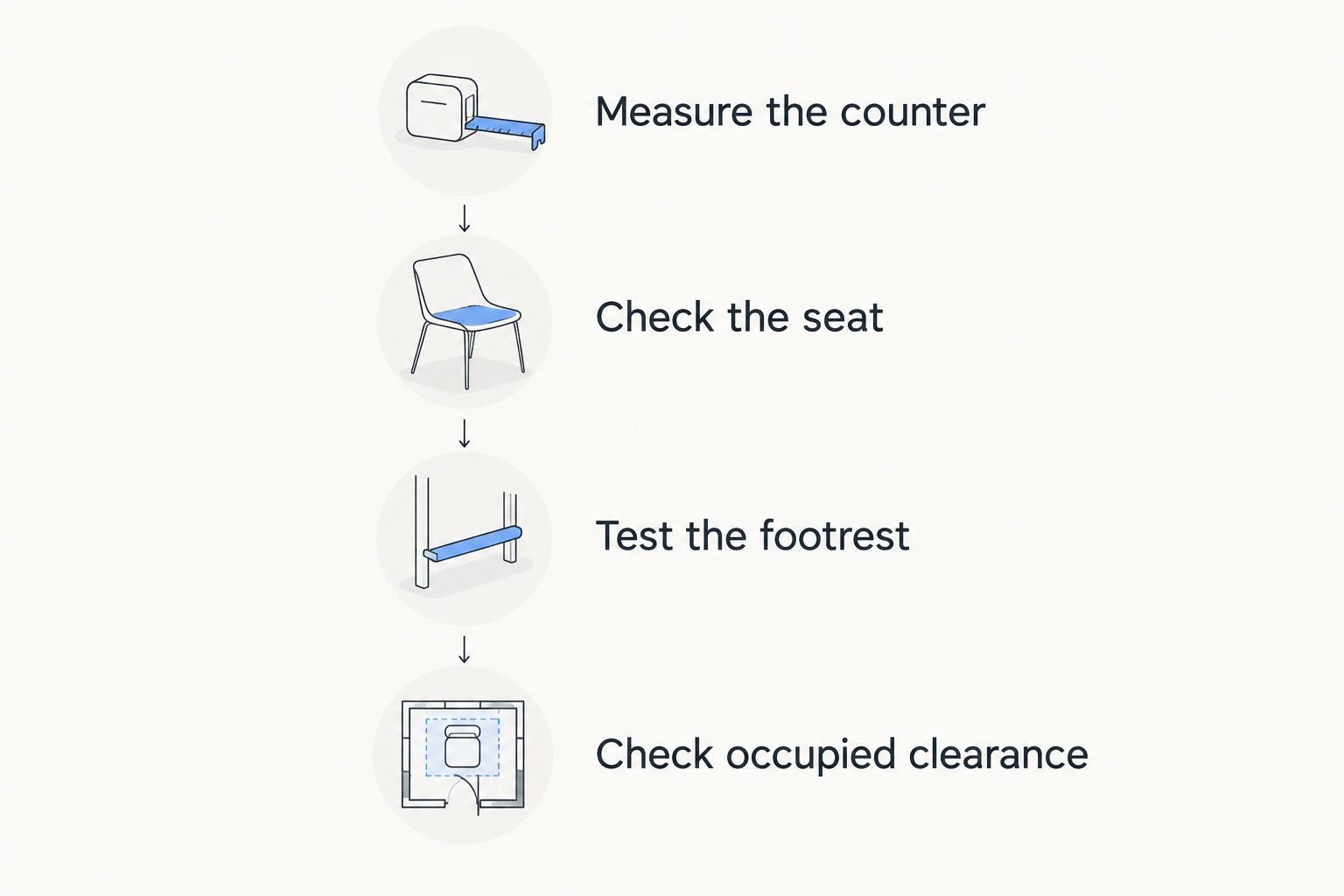
Your 2026 purchase specification should record both the stool dimensions and the counter conditions used to approve them. That gives replacement orders a clear reference instead of relying on a remembered appearance.
Build a specification your team can use
A useful seating specification connects design approval with everyday operation. For your Mondo Contract shortlist, keep these checks attached to each candidate rather than scattered across emails:
- Use and location: Indoor bar, dining counter, or outdoor terrace.
- Fit: Seat height, overall dimensions, counter clearance, and footrest position.
- Materials: Frame, finish, upholstery, and approved cleaning instructions.
- Maintenance: Inspection points, replaceable components, and access to fasteners.
- Sample approval: The exact configuration assessed in the intended layout.
Ask whoever cleans the restaurant to review the sample. A seam that looks unobtrusive in a photograph can still require a different cleaning method from the surrounding surface.
Also assign responsibility for inspections. Identifying a loose footrest is useful only when your team knows who removes the stool from service and arranges the repair.
How we ranked these stool configurations
This 2026 ranking prioritizes commercial suitability, counter fit, guest support, cleaning access, serviceability, and occupied clearance. Fixed-back metal-frame stools take the default position because they combine back support with a stationary seat; each alternative wins a distinct use case.
The ranking is a specification guide, not a claim that every model within a category performs equally. Construction and documented intended use decide whether an individual stool belongs in your restaurant.
Which commercial bar stools should you choose?
Start with fixed-back metal-frame stools for general indoor bar service. Move to wood frames for a dining-led interior, backless seats for deliberately shorter stays, swivel seats for conversational layouts, or outdoor-rated construction for terraces.
For a 2026 Mondo Contract evaluation, approve the exact stool configuration against your counter and service routine before committing to the full layout. The right category narrows the decision; the sample confirms the fit.
FAQ
What's the best type of commercial bar stool for a restaurant?
Fixed-back metal-frame stools are the default recommendation for general indoor restaurant bar service. Confirm commercial suitability, seat-to-counter fit, cleaning requirements, and construction for the exact model.
What seat height do I need for a restaurant bar?
Bar-height seats commonly measure 28–30 inches for counters around 40–42 inches high. Measure the counter underside as well as its top because aprons and brackets reduce usable legroom.
Are backless stools good for restaurant dining?
Backless stools suit compact seating intended for shorter visits, but they provide no back support. Choose backed seating when support during a longer meal is a priority.
Are swivel stools better than fixed stools?
Swivel stools are better when guests need to change conversational direction without turning the base. Fixed stools avoid the swivel mechanism and its associated maintenance points.
Can indoor commercial bar stools be used outside?
Use a stool outdoors only when the exact product is specified for that setting. A metal frame alone does not establish that its finish, hardware, seat, and cushions suit outdoor exposure.
What should I check before ordering restaurant bar stools?
Check intended use, dimensions, counter clearance, footrest position, care instructions, and maintenance access. Assess an exact sample in the planned seating layout before approving the full order.
Do commercial restaurant stools need regular inspections?
Include restaurant stools in a routine inspection plan covering joints, footrests, glides, seat attachments, and any swivel hardware. Remove a stool from service when damage or looseness makes its condition unsafe.
One last thing
Test the stool at the end of a cleaning cycle, not just at the beginning of a design presentation. Move it, clean beneath it, inspect its seat edges, and put it back into position. That simple rehearsal exposes operational friction that a finish sample and an empty-room photograph cannot show.